 English
 Español
 Português
 Français
Articles
What is Coherent Optics - Part 3
4 min read

Applications - dci
- The largest cloud infrastructure operators and internet content providers are moving from leasing bandwidth from service providers networks to leasing or buying dark fibers and building private networks. These networks are increasingly dependent on higher speed optical solutions. Traffic between data centers is increasing at a faster rate than traffic between users and the data centers.
- Many enterprises are moving from operating their own datacenter to cloud based services that offer lower cost and greater flexibility to scale as their needs increase. This transition is leading to larger data centers where resources are consolidated. The interconnect requirements for these mega-data centers are driving demand for solutions that are optimized for these point to point links. Instead of many smaller data centers with moderate connectivity requirements, these mega-data centers require massive bandwidth over fewer paths. This architecture reduces the need for granularity and places the highest value on cost per bit.
- Traffic patterns in the cloud networks are different from traditional data centers. Where the traditional network has a lot of north-south traffic between the servers and users, cloud networks have far more east-west traffic between servers. This traffic is used for synchronization and load balancing to maximize the utilization of available resources.
Applications - metro carrier
- Metro carrier optical networks interconnect a wide range of traffic from central offices and data centers within a metropolitan area. These complex mesh networks typically cover ranges from 80km to 1,500km and may include up to 24 remote optical add-drop mux (ROADM) nodes that introduce additional optical impairments. Metro networks are optimized for small physical footprints and low power, but must deliver ever-more bandwidth to meet customer needs.
- While coherent technology was first adopted in long haul networks, the introduction of Acacia's low power, pluggable coherent CFP module in 2014 made coherent much more appealing in metro applications. Old fiber and wavelength selective switch (WSS) based ROADM nodes in metro networks introduce impairments, such as polarization mode dispersion (PMD), polarization dependent loss (PDL), and reduced channel passbands. These impairments are often more severe in metro than in long haul networks. For this reason, reach alone is not a good indicator of performance requirements in these applications.
Applications - long haul
- Long haul terrestrial networks link major population centers within continents, spanning distances from 1,500 km to more than 2,500 km. Today's cloud networks are constantly mirroring data between servers in geographically diverse locations. Cost effective upgrades and expansion to 100 Gbps and above is necessary to meet this growing need for data. Long haul terrestrial and subsea networks must be upgraded to provide higher bit rate dense wavelength division multiplexing (DWDM) technology to carry data from different sources simultaneously.
- Long haul networks put a high value on performance. The ability to communicate over longer distances reduces the number of regeneration stages, where signals are converted from the optical domain to electrical and back. This can have significant cost savings to the overall network. In addition to prioritizing reach, it is important to maximize the amount of traffic on each fiber, known as the spectral efficiency. Coherent technology has very high spectral efficiency and enables network operators to maximize their utilization of this constrained resource.
Promoting CFPx dco for « zr » applications
- Getting information about the host, especially for CFP2 DCO there may be issues related to power consumption
- Payload (100GE or OTU4?). In case of OTU4, will the host FEC be used or not?
- What equipment is on the far side of the link? This is essential information that will have impact on the configuration of the units. Ideally, Skylane provides the optics for both ends
- Most of the configuration settings described in the next slide have to be done prior to shipment or with Skylane personnel on site (especially if we did not supply the optics for the other side of the link)
- Skylane will develop a tuning box for wavelength tuning and (maybe) for output power control. The box will not allow any other configuration of the DCO
Configuration of CFPx dco for « zr » applications
- Fixed optical output power
- No TOF
- DWDM (50GHz) tunable (with tuning box)
- DP-QPSK
- FEC: OTU4 (transparent, HD-FEC (7%) as per G.709 or SD-FEC (15%, proprietary))
- FEC: 100GE (HD-FEC (7%) as per G.709 or SD-FEC (15%, proprietary))
- Fixed output power
- CD compensation search upper limit set to 1600ps/nm
- The necessary memory contents for host compatibility (basically what we do for non-coherent 100G CFPx parts)
 Celebrating 4 Years as Part of the Amphenol Family
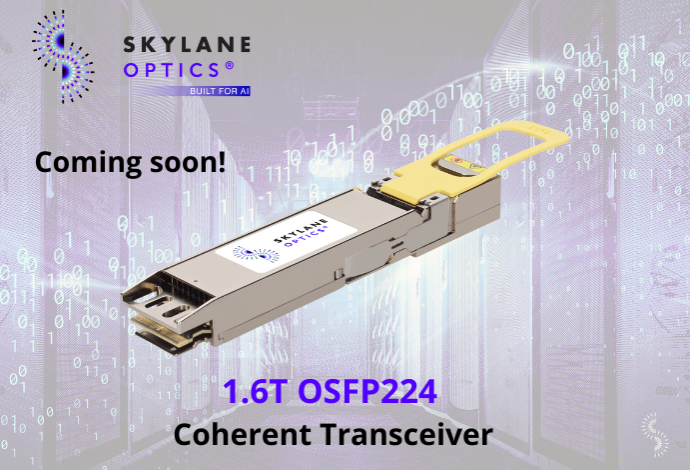 New era 1.6T OSFP224 2xDR4 Transceivers
 Como usar EDFAMUX para expandir a rede óptica sem aumentar custos
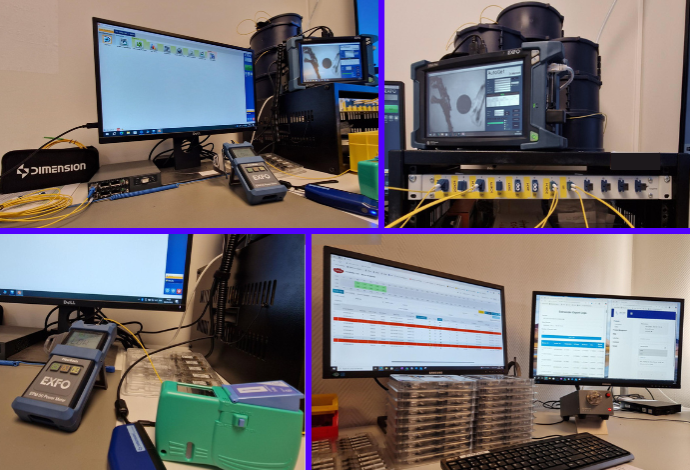 How We Test Our Compatible Optical Components
 What is an Optical Transceiver?